New York has a talent for turning ordinary milestones into competitive sports, and applying to school for a three- or four-year-old is a marquee event. Somewhere between the first "so, where are you applying?" at the playground and a group chat running on pure adrenaline, every parent arrives at the same question: when are we actually supposed to start? And the answers — "the September before," "eighteen months out," "oh, you're already behind" — are contradictory enough to induce a small, specific panic.
Here's the reframe that makes the whole thing tractable: there is no single NYC school admissions timeline. There are two, running at the same time on different clocks — the private (independent) school clock and the public school clock — and they are not synchronized. Most of the stress people describe isn't really about deadlines; it's about trying to run both races at once without noticing they keep different time. Separate them, and each turns out to be surprisingly orderly.
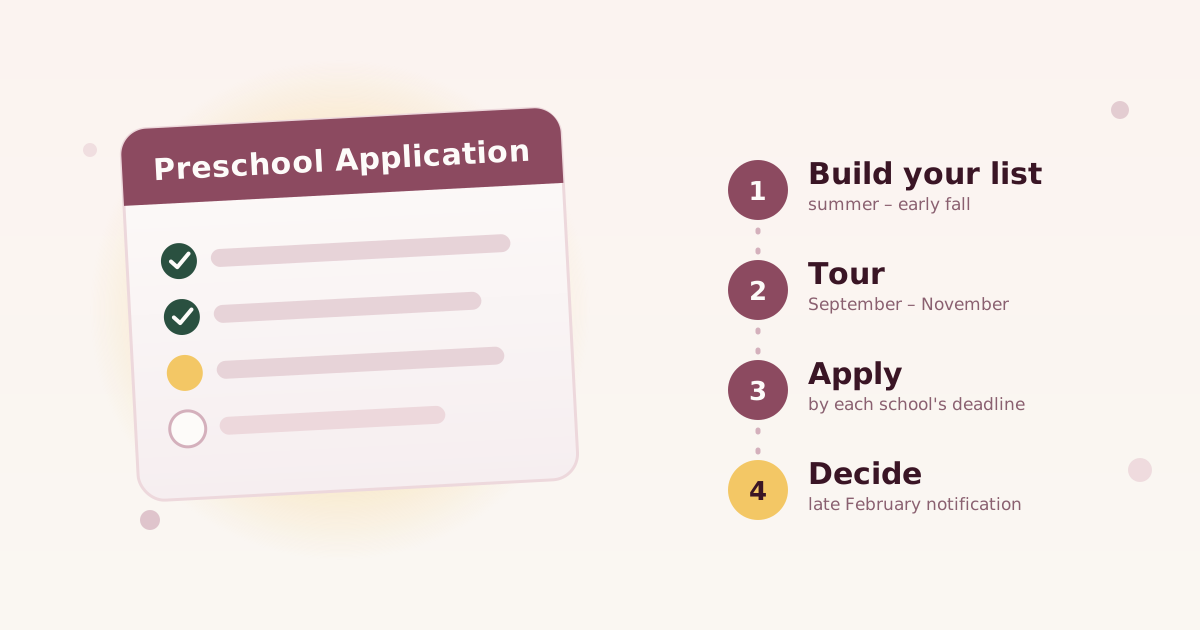
The short version: For private preschool and kindergarten, the cycle begins the year before your child would start — applications open in late summer, deadlines land in early January, and offers arrive in February. For public programs (3-K, Pre-K, and kindergarten via MySchools), you apply in the winter before entry — and, crucially, it's not first-come, first-served. Now the details.
One caveat before the calendar: these are the typical rhythms, and exact dates drift a little each year. The private notification dates are standardized across most independent schools and barely budge; the public dates move by a week or two. On The Foyer, every school carries its own application-open, deadline, and notification dates, so once you've built a shortlist you can see your family's real calendar instead of a generic one.
The private-school clock: when independent school applications open
If independent (private) schools are on your list, the process runs on a nearly year-long arc that begins the summer before the fall you'd apply. For a child starting in September 2027, that means the work starts in the summer and fall of 2026.
Late summer (August–early September) — applications open. Most independent schools release applications between August 1 and mid-September. This is when you build your list and start submitting. Worth knowing: many schools cap applications either by a set number or a fixed deadline, so for the sought-after ones, "open" is less an invitation than a starting gun.
Fall (September–December) — tours, open houses, and visits. The busy season. Schools run open houses and tours from September through December, and showing up matters more than parents expect — attendance is one of the ways schools gauge genuine interest, and the fastest way for you to learn whether a place actually fits your kid. Alongside tours, most schools schedule a child visit, playgroup, or parent meeting. This stretch also holds the optional Early Notification round for qualifying families — siblings of current students, legacy, and faculty/staff children — with decisions around early December.
Early January — the deadline. Independent schools observe a shared completed-application deadline in early January (it fell on January 8 in the most recent cycle). Application, forms, any required assessments: all in by then.
February — you hear back. Notifications are standardized by entry level, and — this is the part that surprises people — they're staggered:
- Kindergarten families hear first, in early February (around February 5), with replies due roughly a week later.
- Grades 1–8 notifications follow, around mid-February.
- Preschool families hear last, in late February (around February 26), with replies due in early March.
Yes, preschool comes last. If you're applying for a preschool spot, you'll still be refreshing your inbox in late February while kindergarten families already have offers in hand — a small design quirk that reliably tests everyone's composure.
Late February–early March — reply and commit. Once offers land, you have about a week to respond and hold your place, usually with a deposit. The window is short and firm; decisiveness is rewarded.
One age note that catches families off guard, especially at kindergarten: independent schools typically expect a child to turn five by around September 1 to enter kindergarten — a stricter line than the public system's (more on that in a moment). Preschool entry ages vary by program and by whether you're applying for a 2s, 3s, or 4s spot, so confirm each school's cutoff rather than assuming.
The public-school clock: 3-K, Pre-K, and kindergarten deadlines
The public track runs through the City's MySchools system, and it keeps entirely different time. The single most important thing to internalize: public admissions are not first-come, first-served. Submitting the instant the window opens earns you exactly nothing, so you can retire the urge to refresh the page at midnight.
3-K and Pre-K for All — the free public programs for three- and four-year-olds — open in the winter and close in late February (the deadline was February 27 in the most recent cycle), with offers in the spring. Eligibility is by birth year: a child who turns three during the enrollment calendar year is 3-K age; turning four makes them Pre-K age.
Public kindergarten runs a touch earlier: applications open in December and close in mid-to-late January (December 10 to January 23 in the most recent cycle), with offers in the spring — late March, that year. Placement runs off your zoned school plus a set of preferences and, where demand outstrips seats, a lottery. Public kindergarten uses the turn-five-during-the-calendar-year cutoff — effectively December 31 — which is roomier than the private September 1 line. That's why a child with a fall birthday can be kindergarten-eligible in the public system while a private school would hold them a year; in fact, about a third of NYC's entering kindergartners are still four when school starts.
Weighing Gifted & Talented? It's a separate public process with its own testing and timeline, layered on top of the standard kindergarten application — plan for it as an addition, not a substitute.
Where the two timelines collide
Here's the friction no single calendar captures, and the real reason this all feels harder than it should: the private track asks you to commit before the public track has answered. Independent-school offers and deposit deadlines land in February and early March. Public offers often don't arrive until spring. So a family running both tracks can be asked to accept — and put money down on — a private seat before they know their public outcome.
There's no clever workaround; the mismatch is baked into the calendars. But seeing it coming changes how you plan. It's why families seriously weighing both keep one private option they'd be genuinely happy to say yes to, budget for a deposit they might ultimately forfeit, and decide in advance how they'll choose if the private "yes" arrives before the public one. Make that decision in the calm of autumn — not in the crucible of a 48-hour reply window.
NYC school application timeline at a glance
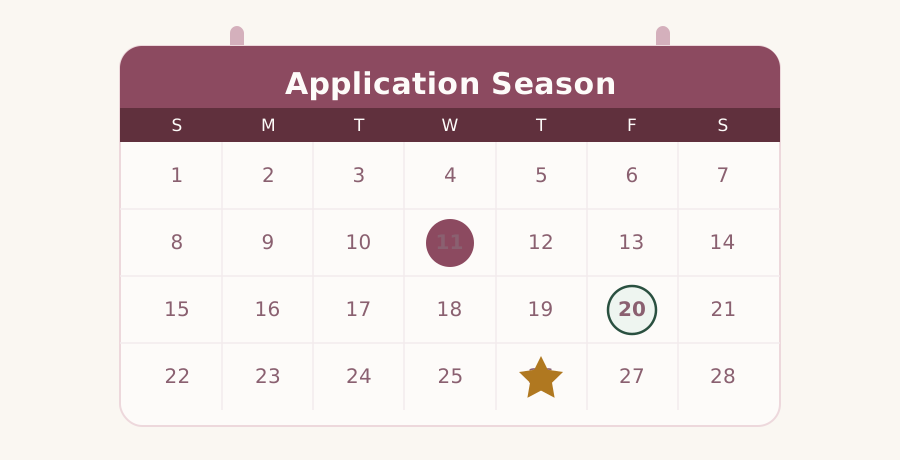
For a child starting school in September 2027, the shape of the year:
- Summer–early fall 2026 — independent-school applications open; build your list and begin.
- Sept–Dec 2026 — tours, open houses, child visits; private Early Notification (early December).
- December 2026 — public kindergarten applications open.
- Early January 2027 — independent-school application deadline.
- Mid–late January 2027 — public kindergarten deadline.
- Early February 2027 — private kindergarten notifications; replies due about a week later.
- Late February 2027 — public 3-K / Pre-K deadline; private preschool notifications.
- Late Feb–early March 2027 — private preschool replies and deposits due.
- Spring 2027 — public offers arrive (kindergarten offers landed in late March in a recent cycle).
Frequently asked questions
When should I start applying to preschool in NYC? For private preschools, begin the summer before you'd enroll — applications open in August and September, so build your list in late summer and submit in early fall. For public 3-K and Pre-K, you apply in the winter before entry (deadline around late February), and applying early gives you no advantage.
When do NYC private school admissions decisions come out? On a standardized schedule: kindergarten offers arrive in early February (around February 5) and preschool offers in late February (around February 26), each with a reply deadline just days later.
Is NYC public school admission first-come, first-served? No. Applications for 3-K, Pre-K, and kindergarten through MySchools are not first-come, first-served — submitting the minute the window opens confers no edge. What matters is applying by the deadline and ranking your choices thoughtfully.
What's the age cutoff for NYC kindergarten? Public kindergarten is open to children who turn five during the calendar year they'd enroll (an effective December 31 cutoff), so some children start at four. Private and independent schools generally expect a child to turn five by around September 1 — a stricter line.
Can I apply to public and private schools at the same time? Yes, and plenty of families do. Just plan around the calendars: private deposits are often due in February or March, before public offers arrive in spring, so decide ahead of time how you'll choose if an offer lands early.
Build your own calendar
Because every school keeps its own exact dates, the generic timeline only gets you so far — what you really want is the calendar for your list. On The Foyer you can compare Manhattan schools side by side and see each one's application-open, deadline, and notification dates in a single place, instead of stitching them together from a dozen tabs at 11 p.m.
Ready to start? Find and compare Manhattan schools on The Foyer.