Few things announce your arrival into New York City parenting quite like the preschool search. One day your child is a baby; the next you're being told, with total seriousness, that you're "late" for a program your two-year-old would start a year from now. The process has a reputation — competitive, opaque, faintly absurd — and some of that is earned. But most of the fog comes from nobody ever drawing you the map.
So here's the map. Applying to preschool in NYC is really just two tracks and four steps, and once you can see the whole thing laid out, it stops feeling like a secret handshake and starts feeling like a to-do list. A long one, but a to-do list.
First, which track are you on?
Almost every NYC preschool falls into one of two worlds, and the first thing to know is that you can play in both at once.
- Private and independent preschools — tuition-based nursery schools, Montessori and Reggio programs, religiously affiliated schools, and the early-childhood divisions of the big K–12 independents. You apply to each school directly, on its own timeline, and most coordinate their offer dates through ISAAGNY.
- Free public pre-K — the city's 3-K (the year your child turns 3) and Pre-K for All (the year they turn 4), run by the NYC Department of Education. One application, no tuition, no fee, assigned through the city's MySchools system.
The two tracks have different applications and different calendars, so pursuing both costs you nothing but effort and gives you the most options come spring. The steps below walk through the private track in detail — the one with the folklore — and then lay out the public track, which is simpler than its reputation.
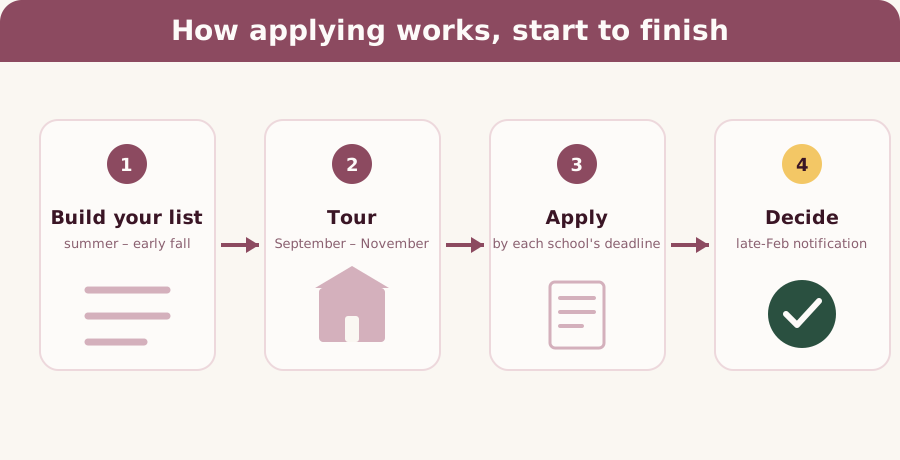
How applying works, start to finish
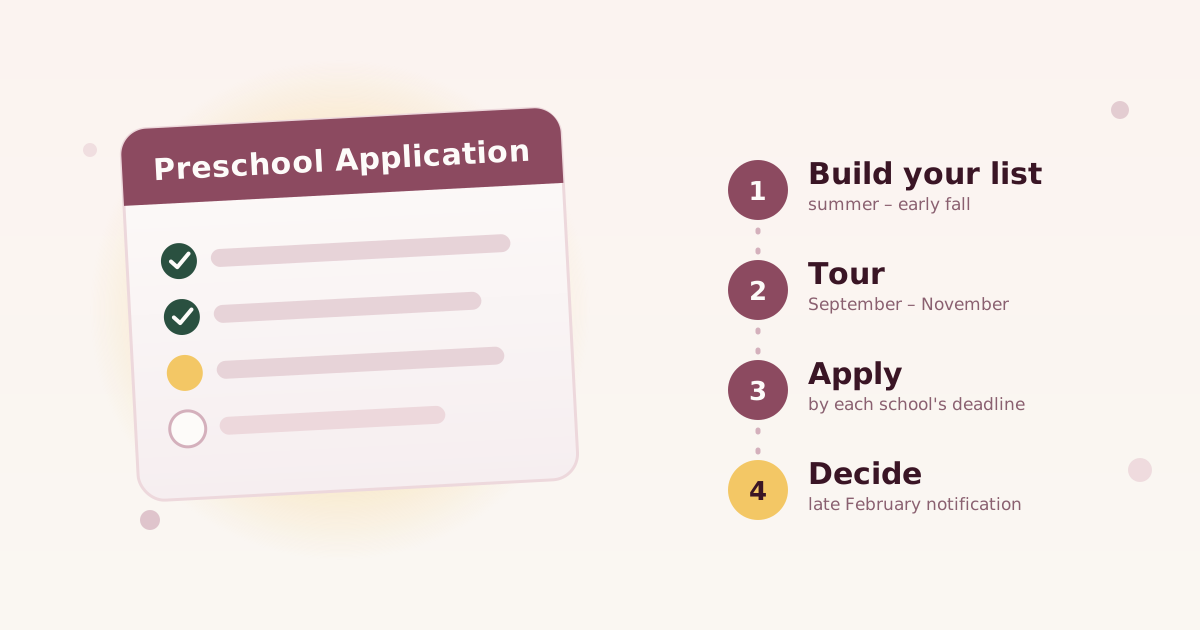
Strip away the anxiety and the private-school process is four moves, in the same order, every year: build a list, tour in the fall, apply by each school's deadline, and hear back on a coordinated date in late winter. Everything else is detail hanging off those four pegs.
Step 1 — Build your list (summer to early fall)
Start before the season does. Over the summer and the first weeks of fall, put together a working list of 6–10 schools that actually fit your family — by neighborhood and commute, by philosophy (play-based, Montessori, Reggio, academic), by schedule (half-day vs. full-day, and whether you need real working-parent hours), and by budget. This is the single highest-leverage thing you'll do, because a thoughtful list makes every later step calmer.
Cast slightly wider than feels comfortable. Popular programs fill fast, odds at any one school are modest, and a list with a couple of realistic "likely" options alongside your dream schools is what lets you sleep in February. You can find and compare Manhattan schools side by side on The Foyer to speed this up — filter by neighborhood, philosophy, schedule, and tuition, then save a shortlist.
Step 2 — Tour and inquire (September to November)
The admissions cycle opens right after Labor Day. As soon as it does, go to each school's website and get on the list — sign up for a tour, an open house, or an information session, and submit any inquiry form. Do this early: tour slots are limited and disappear quickly at the sought-after programs, and at some schools attending a tour is effectively a prerequisite to applying.
Tours run through the fall. Go to as many as you reasonably can, because a school's feel in person is the thing you can't get from a website, and it's usually what makes your final decision for you. Take a quick note after each visit — by November they blur together.
Step 3 — Submit applications (by each school's deadline)
Here's where the private track differs most from public school: there is no single application. You apply to each school separately, on its form, by its deadline, with its fee — usually $50 to $100 per school. Deadlines cluster from October through early December, though some schools run later or on a rolling basis.
A few things that save families grief:
- Deadlines are hard, and earlier is safer. A number of schools review on a rolling basis or fill tour slots first-come — so the calendar rewards the families who move in September, not December.
- Keep a simple tracker. One row per school: tour date, application deadline, fee paid, materials sent. Six to ten parallel deadlines is exactly the kind of thing that slips.
- Not every school uses ISAAGNY. Schools that aren't part of the association set their own dates and may notify earlier — read each one's admissions page so nothing surprises you.
Step 4 — Notification and the reply date
This is the part the coordinated calendar exists to tame. Rather than offers trickling out at random and forcing families into snap decisions, most established preschools notify on a common ISAAGNY date. For nursery and preschool entry, that's a notification day in late February, with a reply date a few days later in early March — so every family is holding its offers at the same time and can weigh them side by side.
You'll get some combination of acceptances, waitlists, and no's. Accept the one you want by the reply date, decline the others promptly so your spot frees up for a waitlisted family, and — if you're waitlisted somewhere you love — send a short, warm note reaffirming your interest. Waitlists do move. Exact dates shift year to year and live on isaagny.org; confirm them for your cycle rather than trusting last year's.
The free public track: DOE 3-K and Pre-K for All
Running quietly alongside all of this is the city's free option, and it's genuinely good. 3-K serves children the year they turn 3; Pre-K for All serves them the year they turn 4. Both are free, both are full school-day, and both use a single application in MySchools where you rank your choices in true preference order. There's no fee and no test — seats are assigned by a matching algorithm with priorities (siblings, district, zone) rather than by the programs themselves.
The public calendar is separate from the private one: applications generally open in the winter and offers come out in the spring, a few months behind the independent-school cycle. 3-K availability still varies by district (it isn't universal everywhere yet), while Pre-K for All is citywide. Because the two tracks are independent, you can pursue both — hold a free public offer while you weigh a private acceptance — just mind each one's reply deadline. The city confirms exact dates each cycle on schools.nyc.gov.
Do you need a "2s" program first?
Short answer: no. A twos program is optional, not a prerequisite. Some families use one for a gentle first separation or for continuity, and a handful of schools give their own twos students a leg up for their threes class — but most children apply fresh for a 3s or Pre-K seat with no formal twos year behind them. If continuity is your reason, ask each school the blunt version of the question: does your twos class actually feed your preschool, or do we reapply? Most do not guarantee it, so don't pay for a twos spot expecting a side door that isn't there.
Start with the list
If this all feels like a lot, that's because it's spread across six months — but on any given week it's just the next small step. And the families who feel calmest in February are, without exception, the ones who built a good list in the quiet of late summer.
So start there. On The Foyer you can find and compare Manhattan schools by neighborhood, philosophy, schedule, and tuition, and save a shortlist you can tour from. For the full month-by-month picture across both the private and public tracks, pair this with our guide to the NYC admissions timeline.
Ready to begin? Find and compare Manhattan schools on The Foyer.