
Few phrases move faster through a NYC playground than "Gifted and Talented." It arrives wrapped in equal parts aspiration and dread — the sense that there's a secret track for four-year-olds, that other families already know something you don't, and that a wrong move in the fall quietly forecloses an option in the spring. So parents do what New York parents do: they start Googling test prep for a child who still negotiates hard over sock seams.
Here's the good news, and it's genuinely good: almost everything you may have heard about G&T admissions is out of date. The test is gone. The frantic prep is pointless. And the process, once you strip away the folklore, is short enough to explain over a single coffee. This is that coffee.
First, what G&T actually is
Gifted & Talented programs are public-school classes and schools designed for accelerated learners — a faster pace, more enrichment, kids grouped with academic peers. They come in two flavors, and the distinction matters more than any other single fact here:
- District G&T programs sit inside a regular public school and mostly serve families who live in that community school district. There are dozens of them across the city.
- Citywide G&T programs are five stand-alone schools open to children from anywhere in New York City: The Anderson School (Upper West Side), NEST+m (Lower East Side), TAG Young Scholars (East Harlem), Brooklyn School of Inquiry, and The 30th Avenue School / STEM in Queens. These are the marquee names, the ones people mean when they lower their voice — and, precisely because anyone can apply, the hardest seats in the system to land.
Both are free. Both are public. The difference is who's eligible to apply and, therefore, how brutal the odds are.
The part everyone gets wrong: there is no test
For years, entry to kindergarten G&T ran on a standardized exam — a one-on-one assessment of a four-year-old, with a whole cottage industry of prep books and tutors grown up around it. That test was eliminated in 2021, and it has not come back. If someone tries to sell you G&T test prep, they are selling you preparation for an exam that no longer exists.
Here's what replaced it:
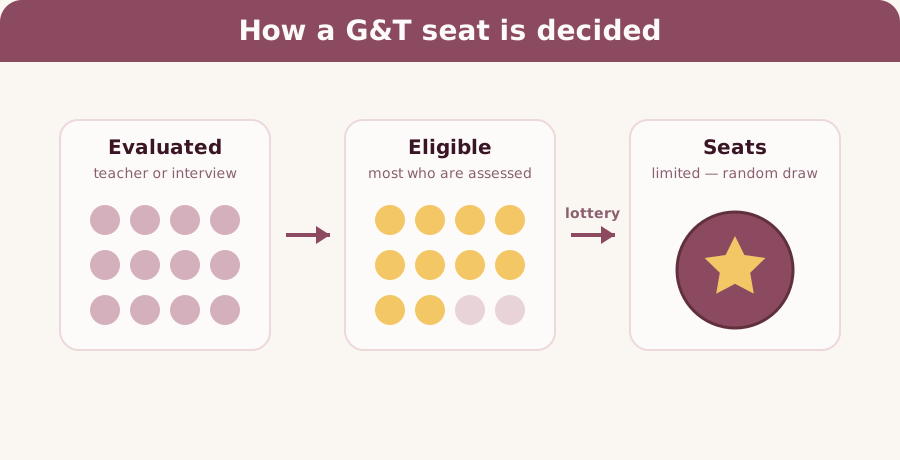
- If your child is in a DOE (public) pre-K, their current pre-K teacher completes an evaluation of the child's readiness. In practice, a large majority of children who are evaluated are found eligible.
- If your child is not in a DOE pre-K — private preschool, parochial, a home setup, or not in school yet — the city contacts you after applications close and schedules a short interview, where an early-childhood educator assesses the child through age-appropriate activities.
Either way, the output is a yes/no: is this child eligible. Which brings us to the single most important sentence in this whole guide.
Eligibility is not a seat
Being found eligible does not get your child into a G&T program. It gets them into a lottery. Because far more children are deemed eligible than there are G&T seats, admission is decided by a random draw among eligible applicants, ranked by the choices you listed. Eligibility is the ticket into the raffle; the raffle still has to break your way.
This reframes the entire endeavor. There is no performance to optimize, no way to "win" the assessment beyond your child having a good, unremarkable day. The stress that used to go into prep has nowhere useful to go — which, if you let it, is enormously freeing. You cannot study for a coin flip.
It also means you should hold the outcome loosely. Plenty of wonderful, obviously-bright kids don't draw a G&T seat, especially at the citywide five. That's the math of a lottery, not a verdict on your child.
How you actually apply
This trips people up because there's no separate "G&T application." G&T lives inside the regular kindergarten application in the city's MySchools system. You add G&T programs to your kindergarten choices, rank everything in true preference order, and submit — one application, doing double duty.
A few things worth knowing as you build the list:
- Ranking G&T costs you nothing. Adding G&T programs does not reduce your priority for your zoned school. If no G&T offer comes, you keep your standard kindergarten placement. There is no downside to including it.
- Rank by genuine preference, not strategy. MySchools uses a matching algorithm; listing a program you'd actually attend higher than one you wouldn't is always the right move. Gaming the order backfires.
- The citywide five are the longest shots. If your heart is set on a citywide program, list it — but pair it with district G&T and strong zoned/unzoned choices so the plan doesn't rest on the least likely outcome.
The 2026–27 calendar at a glance
Because G&T rides along with the kindergarten application, it keeps the kindergarten calendar. For a child entering kindergarten in September 2027, here's the shape of the year (the city confirms exact dates each cycle on schools.nyc.gov):
- December 9, 2026 — the kindergarten application, with G&T programs, is expected to open in MySchools.
- Mid-to-late January 2027 — application deadline (around January 22). Deadline day, not opening day, is what matters; it is not first-come, first-served.
- After the deadline — evaluations for DOE pre-K students, and interview scheduling for everyone else.
- Late March 2027 — offers are released in MySchools, the same day as kindergarten offers (around March 30).
Two footnotes. First, eligibility for entry is by birth year — for fall-2027 kindergarten, that's children born in 2022. Second, kindergarten isn't the only door: the city also runs a separate grades 1–3 G&T process in the spring, judged on report-card grades rather than an early-childhood assessment, so a child who isn't in a G&T seat at five isn't shut out forever.
One thing to keep an eye on
G&T is politically contested in New York, and the ground has shifted before — the 2021 elimination of the test being the obvious example. Mayor Mamdani has signaled that he'd like to phase out kindergarten-entry G&T and move gifted identification to later grades, closer to third grade. As of the 2026–27 cycle, nothing has changed — kindergarten G&T is running normally, on the calendar above. But if you're planning more than a year out, it's the one policy worth re-checking before each cycle, since a change here would reshape the whole entry point.
So should you do it?
For most families the honest answer is: sure, add it, hold it lightly. It's free, it doesn't cost you your zoned school, and there's nothing to prepare — so the "expected value" of listing a G&T program or two is simply positive. What's not worth doing is reorganizing your family's fall around it, buying prep for a nonexistent test, or treating a lottery miss as a referendum on your kid.
And keep the real question in view underneath the label. "Gifted & Talented" is an admissions category, not a guarantee of fit. A calmer, warmer, closer non-G&T school can be the better choice for a particular child than a citywide program with a famous name and a 45-minute commute. Prestige is easy to rank; fit is the thing that actually shows up at 8am every morning.
Build your own list
The smartest move you can make this fall isn't prep — it's a good list. G&T programs slot in alongside your zoned school, district options, and any private choices you're weighing, and the families who feel calmest in the spring are the ones who built a ranked shortlist in the quiet of autumn. On The Foyer you can find and compare Manhattan schools side by side, and if you want the full month-by-month picture across both the public and private tracks, start with our guide to the NYC admissions timeline.
Ready to start? Find and compare Manhattan schools on The Foyer.